
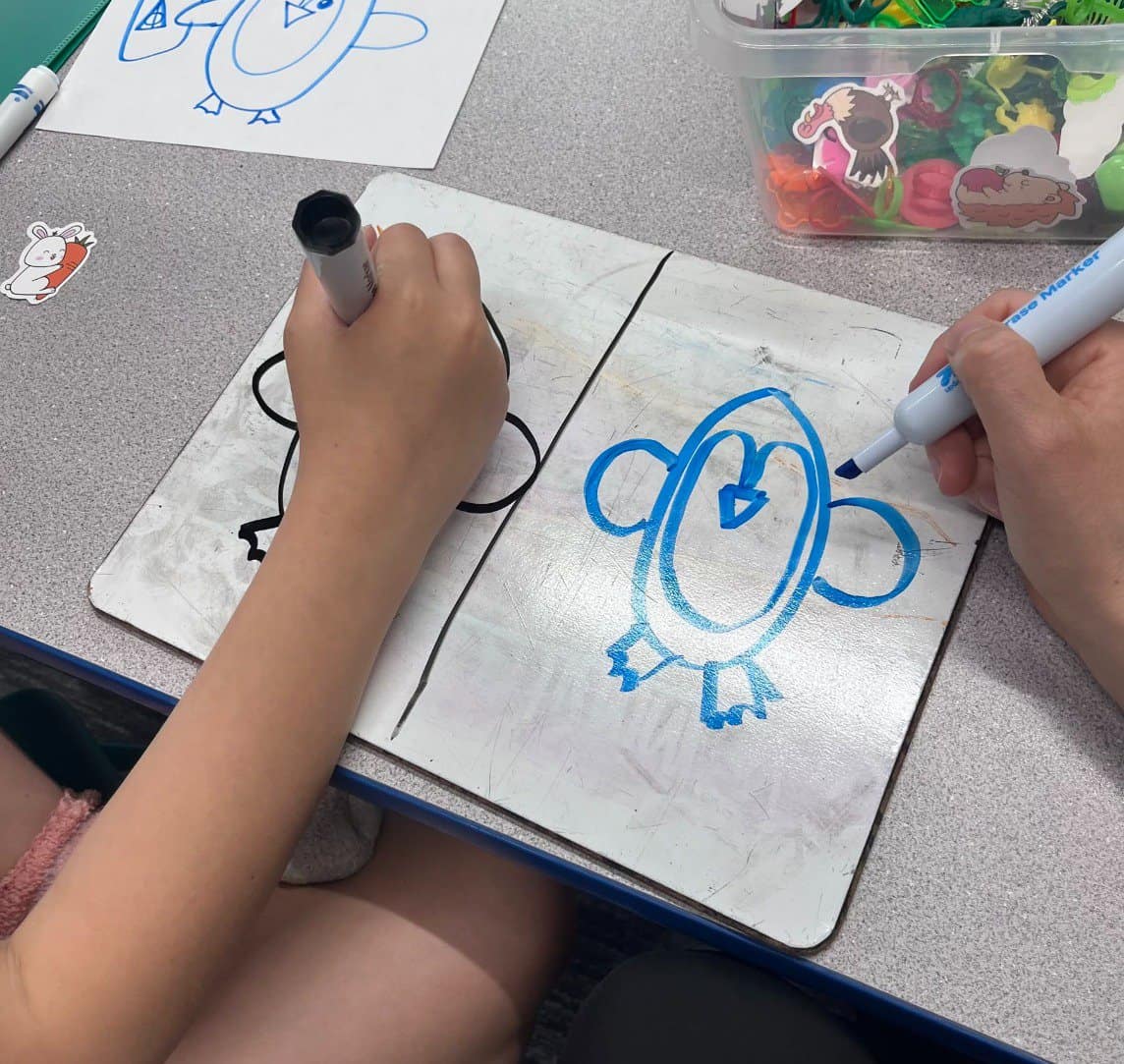
At Strengths in Motion – Speech & Occupational Therapy, we love turning everyday moments into meaningful learning. Recently, one of our clients “taught” us how to draw a penguin—and the benefits went far beyond a cute picture. By letting the child take the lead, we practiced speech sounds in conversation, expanded language, and strengthened planning skills—all in a way that felt fun and empowering.
This child-led approach works beautifully at home, too. When children become the teacher, they’re practicing important communication, motor, and thinking skills without even realizing it. Plus, kids love being the expert.
Why This Works
Letting your child teach you taps into multiple developmental areas:
- Speech and language: sequencing, describing, retelling, giving and following directions, and practicing specific speech sounds in connected speech.
- Social communication: perspective taking (“What does my listener need to know?”), turn-taking, clarifying, and repairing breakdowns.
- Executive functioning: planning, organizing thoughts, sequencing steps, and flexible thinking when plans change.
- Occupational therapy skills: fine motor control, visual-motor integration, bilateral coordination, and sensory regulation—especially with hands-on tasks like drawing, building, or crafting.
- Feeding therapy foundations: exposure to new foods, describing textures and tastes, planning simple snack steps, and increasing confidence in the kitchen.
Try It at Home: Step-by-Step
- Choose a “teach-me” topic your child loves
- Ideas: draw a favorite animal or character, build with LEGOs, make a simple snack, set up a race track, craft a bookmark, plant a flower, or explain how to play a favorite game.
- Set the stage
- Tell your child: “I’ve never done this before. Will you teach me how?” Give them the role of expert and yourself the role of curious learner.
- Gather simple materials
- Keep it accessible: paper and markers, a small LEGO set, a few snack ingredients, or a basic craft kit.
- Encourage sequencing and clear instructions
- Use prompts like: “What comes first?” “Can you show me?” “What should I do next?” “How will we know we’re done?”
- Model active listening
- Follow their directions, ask clarifying questions, and let them correct you. Celebrate their coaching!
- Add just-right challenges
- If the task is too easy, ask for more detail (“What kind of beak?” “How many blocks long?”). If it’s too hard, offer a visual (checklist, picture, or first/then board) or co-create steps.
- Reflect together
- Wrap up with a quick retell: “First we…, then we…, last we….” Ask, “What would you change next time?”
Skill Targets You Can Support
- Speech sounds and articulation
- Build in target sounds naturally: “Let’s use big circles—ssssso many circles!” “Please pass the blue blocks, please.”
- Language development
- Sequencing: “First… next… then… last…”
- Describing: color, size, shape, function (“It’s a small, fluffy, black-and-white penguin with an orange beak.”)
- Retelling: “Tell me how you did it, step by step.”
- Fluency and pacing
- Keep a calm pace, reduce time pressure, and show you’re listening. If your child stutters, allow extra time and avoid interrupting.
- Social-pragmatic communication
- Perspective taking and clarity: “What do I need to know to do it right?” “Can you show me with your hands?”
- AAC and supports
- Encourage modeling on your child’s AAC device or visuals for key words like “go,” “put,” “on,” “next,” and “finished.”
- Occupational therapy goals
- Fine motor and visual-motor: drawing shapes, cutting simple lines, placing small blocks.
- Motor planning and bilateral coordination: stabilizing paper with one hand while drawing with the other, snapping blocks together.
- Sensory regulation: using movement breaks or deep pressure before/after, adjusting noise and lighting to comfort.
- Feeding therapy foundations
- Snack-making builds tolerance for new foods, explores textures and smells, and increases independence with simple, safe steps (e.g., washing fruit, spreading, stirring).
Easy “Teach-Me” Ideas
- Draw a favorite animal or character
- Build a specific LEGO structure
- Make a simple snack (trail mix, fruit kabobs, cracker-and-spread)
- Explain how to play a favorite board or video game
- Construct a race track or marble run
- Create a simple craft (bookmark, paper puppet)
- Plant a seed or small flower
Adaptations by Age and Ability
- Early learners (2–5)
- Keep steps short (2–3 steps), use pictures or gestures, and model language: “Draw circle. Add eyes.”
- School-age (6–10)
- Expand details: “Give me three clues.” “How can we fix it if I make a mistake?”
- Tweens and teens
- Add planning tools: outline steps, estimate time, and review results. Encourage leadership with siblings.
- Neurodiversity-affirming strategies
- Accept scripts and special interests—use them! Offer choices, reduce pressure, and allow movement or fidgets.
- AAC users
- Pre-teach key words, model on the device as you go, and celebrate any communication—points, gestures, vocalizations, or buttons.
Quick Prompts You Can Use
- “Teach me how to do it—what comes first?”
- “Show me with your hands. Can you tell me, too?”
- “I’m confused—can you say it another way or draw it?”
- “Let’s make a checklist together.”
- “Tell me the steps we did—first, next, last.”
Safety and Setup Tips
- Snack activities
- Adult supervision is essential. Keep knives sharp and out of reach unless you are teaching with a child-safe tool. Avoid choking hazards for younger children. Wash hands and surfaces.
- Building and crafting
- Clear a small workspace, keep materials organized, and use child-safe scissors and non-toxic glue.
- Sensory comfort
- Offer a quiet corner, noise-dampening headphones, or movement breaks as needed.
What to Notice and Celebrate
- Clearer directions and richer vocabulary
- Longer attention and persistence with a task
- Flexible thinking when something doesn’t work
- Pride and confidence in leading the activity
Try the penguin-drawing lesson, a “teach-me” LEGO build, or a simple snack demo this week. You might be surprised by how much communication and coordination your child practices—just by being the teacher.
We’re Here to Help
Strengths in Motion – Speech & Occupational Therapy provides pediatric speech, occupational, and feeding therapy tailored to your child’s strengths and interests. If you’d like ideas customized to your child’s goals or want support with speech sounds, language, social communication, sensory regulation, fine motor skills, or picky eating, our team is ready to help.
- Schedule an evaluation or consultation
- Ask for a home-practice plan built around your child’s interests
- Learn coaching strategies you can use during everyday routines
Every child can make meaningful progress with the right supports—and a little creativity. Let’s get them moving forward, one “teach-me” moment at a time.

0 Comments