

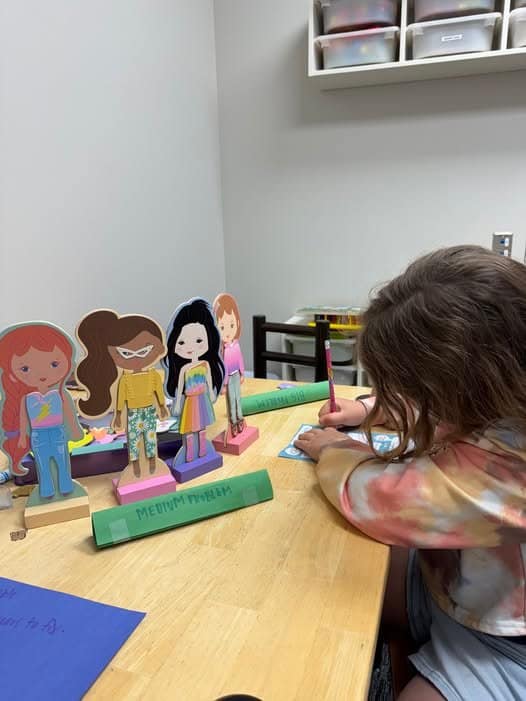
We’ve all been there. Whether it’s us or our little ones, some days just seem to pile on the challenges. Maybe a planned outing gets cancelled, a friend says something hurtful on the playground, or even a scene in a familiar movie feels unexpectedly scary. For adults, we might vent to a friend, go for a walk, or find a quiet moment to process. But what about our children? Their world isn’t always equipped with clear ways to express these complex emotional storms.
Think back to that moment – perhaps you recently saw our Facebook post about our clinic dolls having a rough day? Their story involved unkind friends at school, a scary movie scene that lingered, and the ultimate disappointment: rain cancelling outdoor play just as they were ready. For young children, this isn’t just a series of minor inconveniences. These different stressors, hitting one after another (or even all at once!), can trigger a cascade of “big feelings” – frustration, sadness, fear, anger, and disappointment.
Why Big Feelings Feel So Big for Kids
It’s important to remember that a child’s brain is still developing rapidly, especially the parts responsible for managing emotions, thinking flexibly, and problem-solving (the prefrontal cortex). When intense feelings bubble up, they can easily overwhelm a child’s limited coping toolkit and undeveloped capacity for rational thought. They might express these feelings through meltdowns, withdrawal, physical complaints, or even unexpected behaviors that leave us scratching our heads. They have the experience of the emotion but often lack the language and internal strategies to make sense of it and manage it effectively.
This is where the superpower of childhood comes in: Play!
Play as the Child’s Language of Processing
For kids, play isn’t just about having fun or passing the time. It is their primary way of exploring the world, practicing skills, and, crucially, processing their experiences and emotions. When they encounter a challenging situation in real life, unresolved feelings don’t just disappear. They often show up later in their play.
Have you ever noticed your child acting out a scenario that happened earlier in the day? Or perhaps they use dolls or action figures to recreate something that seemed to bother them? This isn’t random imitation; it’s their brain actively working through the event in a safe, controlled environment.
Role-Playing: A Therapeutic Stage for Emotions
The kind of play we highlighted with our dolls – role-playing – is particularly powerful for emotional regulation. During role-playing, children can:
- Revisit and Re-experience (Safely): They can recreate the challenging scenario, but this time, they are in control. The scary movie can be paused or given a different ending. The unkind friend can be given a talking-to or choose to walk away. This shift from feeling powerless in the moment to feeling empowered in the play is incredibly therapeutic.
- Name and Understand Emotions: As they act out scenes, you can gently introduce language for the feelings involved. “The dolly looks really sad that it’s raining.” “The bear is feeling very angry that his block tower fell.” Putting words to these internal states is a foundational step in emotional intelligence and regulation.
- Experiment with Solutions: In real life, a child might not know how to respond when a friend is unkind. In play, they can try different approaches. Should the dolly tell the teacher? Ignore it? Say “I don’t like that”? Play provides a consequence-free space to practice assertion, problem-solving, and finding ways to cope.
- Develop Empathy and Perspective: When role-playing includes interactions between characters, children naturally engage in perspective-taking. They might act out the feelings of the “unkind friend” or the “scared character,” helping them understand that others have feelings too.
- Integrate Experiences: By acting out real-life events in a playful narrative, children integrate the experience into their understanding of the world. It helps make overwhelming moments feel smaller, more predictable, and ultimately, more manageable. Play transforms potential trauma or confusion into a story they can understand and learn from.
How Strengths in Motion Supports Play and Emotional Growth
At Strengths in Motion, we understand that emotional regulation is deeply connected to communication skills (Speech Therapy) and sensory processing, motor planning, and social interaction abilities (Occupational Therapy). Play is the cornerstone of our therapeutic approach.
Our therapists use play – including role-playing, sensory play, and imaginative scenarios – to create a safe space for children to:
- Learn and practice using language to express how they feel.
- Develop social communication skills needed for navigating friendships and conflicts.
- Explore and manage their sensory responses, which are often intertwined with emotional states.
- Build the foundational skills for self-regulation and adaptive coping strategies.
Through playful interaction, we help children build the “strength in motion” not just in their bodies and voices, but also in their hearts and minds.
Supporting Your Child’s Play Journey
So, the next time you see your child engrossed in play, especially role-playing scenarios that mirror real-life events, know that it’s more than just pretend. They are doing vital emotional work. You can support this by:
- Providing unstructured time for play.
- Offering props like dolls, puppets, or dress-up clothes.
- Gently joining in their play sometimes, following their lead.
- Commenting on the feelings you observe the characters expressing (“Wow, that teddy bear looks really frustrated!”).
By valuing and encouraging play, especially the kind that allows them to process their world, we empower our children to navigate their big feelings with growing confidence and resilience. Play truly is the path to building emotional strength.


0 Comments